
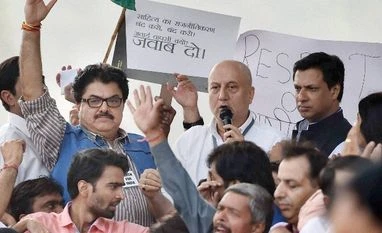
 "People who say that India is going through intolerant times have amnesia: Anupam Kher")


This past week, 24 members of India's film fraternity, including noted film makers Saeed Mirza and Kundan Shah, returned their national awards in a symbolic swipe at what they call "growing intolerance" in the country. Anupam Kher, the 60-year-old actor at the forefront of a counter-protest against those who returned their awards, talks to Shivam Saini about his march to Rashtrapati Bhavan
What led you to organise the march against those raising their voice over "intolerance" in the country?
If some people feel they live in intolerant times, millions of others also feel they don't live in intolerant times and India is very tolerant. I'm in the second section. Like they have the democratic right to say what they want to say, I have the right to say, "No, we don't live in intolerant times."
This is not to counter anybody. I'm not a political party, nor are all the artistes and people participating in the march.
What do you think is prompting Indian artistes to return their accolades? Do you see a collective motive?
I don't want to judge people's motives. But since they say India is going through intolerant times, I feel they have amnesia. Have we not gone through Emergency, the anti-Sikh riots, the Bhagalpur blindings, the Bhopal gas tragedy? If they did not feel the necessity to return their awards for those reasons, even if they were not around at the time, has something as disastrous happened in these 14 months? Of course, human tragedy is very bad. Nobody should be killed for his faith. I'm totally with them on that. But this "intolerance" word - I've not heard it in the last few years as much as I've heard it in the last 15 days. It's a kind of selective outrage.
And, they've taken their fight out of India. Which country does not have its internal problems, but how many countries' scholars go abroad and talk rubbish about their own country?
So, how should people express their disenchantment instead?
When you return an award, you insult the people who gave you that award; you disrespect the President who was there to give you the award. They are film makers and writers. They can write and make movies.
Some of the people who've returned the awards had also started open petitions before the election that Narendra Modi should not be made prime minister. So I do question their motive if they continue to say the same thing.
At the Mumbai Literature Festival, you spoke against the motion, "Freedom of expression is in imminent danger". How do you view your stand, given the recent murder of Kannada rationalist M M Kalburgi?
That evening was a set-up. When [festival organiser] Anil Dharker spoke to me, I said, "You're already taking a position by saying India's freedom of expression is in imminent danger. Would you like to say: is India's freedom of expression in imminent danger?" He said that wasn't the classic way of going about it and it had to be a statement. I said the statement should then be: India's freedom of expression is not in imminent danger. That didn't suit him.
With such a title, we would be having the meeting in a hidden basement had freedom of expression been in imminent danger. But we were having it in the heart of the city, where wine and cheese were being served backstage. Where was freedom of expression in danger?
I also said Shobhaa De should be the last person to talk about freedom of expression because she was the first editor of the Stardust magazine, which wrote that film people only sleep around with each other and do nothing else. Then the audience started booing me. There was no difference between them and goons, because they were talking about freedom of expression being in danger but were taking away mine.
There's also a view that your protest has much to do with the fact that your wife, Kirron Kher, is a Bharatiya Janata Party (BJP) MP.
Ms Kher is a strong lady who can fight her own battle. There are other ways of showing my loyalty to her. I'm a public figure. It's not easy to make a lot of people unhappy. But this is the only defence they can have. People want to attribute motives to somebody's forthrightness and courage. But I grant them their share of insecurity.
Today, everybody is free to talk about which religion they belong to. But I'm noticing a change: one is really very scared to say I'm a Hindu because the moment you say that or put tilak -something you've been doing all your life - suddenly, you're an Rashtriya Swayamsevak Sangh pracharak or a BJP guy. The moment you say you love the cow, you're a Hindu fanatic. It's ironic.
What led you to organise the march against those raising their voice over "intolerance" in the country?
If some people feel they live in intolerant times, millions of others also feel they don't live in intolerant times and India is very tolerant. I'm in the second section. Like they have the democratic right to say what they want to say, I have the right to say, "No, we don't live in intolerant times."
This is not to counter anybody. I'm not a political party, nor are all the artistes and people participating in the march.
What do you think is prompting Indian artistes to return their accolades? Do you see a collective motive?
I don't want to judge people's motives. But since they say India is going through intolerant times, I feel they have amnesia. Have we not gone through Emergency, the anti-Sikh riots, the Bhagalpur blindings, the Bhopal gas tragedy? If they did not feel the necessity to return their awards for those reasons, even if they were not around at the time, has something as disastrous happened in these 14 months? Of course, human tragedy is very bad. Nobody should be killed for his faith. I'm totally with them on that. But this "intolerance" word - I've not heard it in the last few years as much as I've heard it in the last 15 days. It's a kind of selective outrage.
And, they've taken their fight out of India. Which country does not have its internal problems, but how many countries' scholars go abroad and talk rubbish about their own country?
So, how should people express their disenchantment instead?
When you return an award, you insult the people who gave you that award; you disrespect the President who was there to give you the award. They are film makers and writers. They can write and make movies.
Some of the people who've returned the awards had also started open petitions before the election that Narendra Modi should not be made prime minister. So I do question their motive if they continue to say the same thing.
At the Mumbai Literature Festival, you spoke against the motion, "Freedom of expression is in imminent danger". How do you view your stand, given the recent murder of Kannada rationalist M M Kalburgi?
That evening was a set-up. When [festival organiser] Anil Dharker spoke to me, I said, "You're already taking a position by saying India's freedom of expression is in imminent danger. Would you like to say: is India's freedom of expression in imminent danger?" He said that wasn't the classic way of going about it and it had to be a statement. I said the statement should then be: India's freedom of expression is not in imminent danger. That didn't suit him.
With such a title, we would be having the meeting in a hidden basement had freedom of expression been in imminent danger. But we were having it in the heart of the city, where wine and cheese were being served backstage. Where was freedom of expression in danger?
I also said Shobhaa De should be the last person to talk about freedom of expression because she was the first editor of the Stardust magazine, which wrote that film people only sleep around with each other and do nothing else. Then the audience started booing me. There was no difference between them and goons, because they were talking about freedom of expression being in danger but were taking away mine.
There's also a view that your protest has much to do with the fact that your wife, Kirron Kher, is a Bharatiya Janata Party (BJP) MP.
Ms Kher is a strong lady who can fight her own battle. There are other ways of showing my loyalty to her. I'm a public figure. It's not easy to make a lot of people unhappy. But this is the only defence they can have. People want to attribute motives to somebody's forthrightness and courage. But I grant them their share of insecurity.
Today, everybody is free to talk about which religion they belong to. But I'm noticing a change: one is really very scared to say I'm a Hindu because the moment you say that or put tilak -something you've been doing all your life - suddenly, you're an Rashtriya Swayamsevak Sangh pracharak or a BJP guy. The moment you say you love the cow, you're a Hindu fanatic. It's ironic.
You’ve reached your limit of {{free_limit}} free articles this month.
Subscribe now for unlimited access.
Already subscribed? Log in
Subscribe to read the full story →*Subscribe to Business Standard digital and get complimentary access to The New York Times

Smart Quarterly
₹900
3 Months
₹300/Month
SAVE 25%
Smart Essential
₹2,700
1 Year
₹225/Month
SAVE 46%
*Complimentary New York Times access for the 2nd year will be given after 12 months
Super Saver
₹3,900
2 Years
₹162/Month
Subscribe
Renews automatically, cancel anytime
Here’s what’s included in our digital subscription plans
Exclusive premium stories online

Over 30 premium stories daily, handpicked by our editors


Complimentary Access to The New York Times
News, Games, Cooking, Audio, Wirecutter & The Athletic
Business Standard Epaper
Digital replica of our daily newspaper — with options to read, save, and share
Curated Newsletters
Insights on markets, finance, politics, tech, and more delivered to your inbox
Market Analysis & Investment Insights
In-depth market analysis & insights with access to The Smart Investor

Archives
Repository of articles and publications dating back to 1997
Ad-free Reading
Uninterrupted reading experience with no advertisements

Seamless Access Across All Devices
Access Business Standard across devices — mobile, tablet, or PC, via web or app
SAVE 25%