
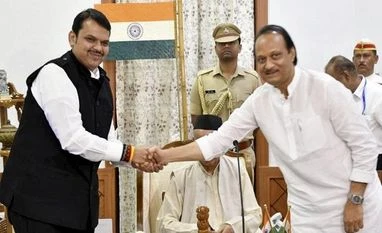
 "How Maharashtra events are 1984 redux, and why NCP needs to reinvent itself")


In July 1984, NT Rama Rao, the then new chief minister of Andhra Pradesh whose Telugu Desam Party (TDP) had won the 1983 Assembly polls with 199 of the 294 seats (a decisive victory by any standards), left for the US for heart surgery.
In less than a month, Governor Ram Lal Thakur, obviously on instruction from then Prime Minister Indira Gandhi, installed NTR’s finance minister, Nadendla Bhaskara Rao, as chief minister, engineering a ‘split’ in the TDP. It was a plan that was worked upon for months. Bhaskara Rao claimed support of 92 MLAs (which soon became 95) of the Telugu Desam, 57 of the Congress(I), five of the All India Majlis-e-Ittihad-ul-Muslimeen (AIMIM), and four independents — thus adding up to 158 or 161.
But 35 MLAs whose names figured on Bhaskara Rao's list held a press conference in Delhi and unanimously stated that their names had been fraudulently included on the list. Bhaskara Rao said he had paraded his followers, including these 35 MLAs, before the governor
A furious M Ratna Bose, then leader of the Telugu Yuvatha, the youth wing of the Telugu Desam and one of the 35 at the time, said: "The fellow (Bhaskara Rao) is a liar. He has defamed us, and we must go to court."
What followed was inevitable. The Bhaskara Rao government lost the vote on the floor of the House. Ram Lal was replaced by Shankar Dayal Sharma, who invited NTR to form a government. But so widespread and visceral was the backlash to the imposition that when Bhaskara Rao went to visit former President N Sanjeeva Reddy in Anantapur, old chappals were festooned from bamboo poles all the way. Women in his coastal Andhra district of Guntur collected old broomsticks to welcome him. In Karimnagar district, a hundred residents of Jagtial constituency sent him a telegram requesting him not to visit there anytime soon. More to the point, when after Indira Gandhi’s assassination a Congress wave swept the country, Andhra Pradesh voted decisively in favour of the TDP: The same Andhra Pradesh that had adored ‘Indiramma’ and her Congress.
There’s a lesson in this somewhere for the Bharatiya Janata Party (BJP) in the current Maharashtra stand-off. Things are expected to become clear on Monday when the Supreme Court decides whether MLAs from the Nationalist Congress Party (NCP) gave signed letters to erstwhile legislature party chief, Ajit Pawar, pledging support to the Fadnavis government or not.
But the more important issue is: How did things come to such a pass?
The problem lies in the way the NCP is structured. The NCP’s founding principle was opposition to the ‘foreign origins’ of Congress President Sonia Gandhi. In all other ideological respects, it is hard to tell them apart from the Congress. Ajit Pawar came into prominence when he was seconded by Sharad Pawar to handle Maharashtra politics, at a time when the senior Pawar was busy in Delhi as defence minister in the PV Narasimha Rao government. Ajit, who had cut his teeth on intrigue and the patronage politics of sugar cooperatives, soon became the sub-boss of a franchise for which staying in power was an end in itself.
The opportunity of arbitrage came in the wake of the hung Assembly poll verdict in 2019. Was a conspiracy afoot even then? Scores of NCP leaders crossed over to the BJP. The most important exit among them was that of Udayanraje Bhosale, an influential three-term sitting NCP MP who joined the BJP. Bhosale, the Lok Sabha MP from Satara, is the 13th direct descendant of Chhatrapati Shivaji, the founder of the Maratha Empire. He was also one of Ajit Pawar's most vocal critics within the party. His departure grievously hurt the NCP in its bastion — the Maratha-dominated western Maharashtra region with 70 Assembly seats.
Vijaysinh Mohite-Patil, a powerful Maratha leader from Solapur district who nursed a grudge against Ajit Pawar also quit the NCP and joined the BJP. He felt justice had not been done to him: He should have been the one to be appointed legislative party leader after it was he who was elected to the post by NCP MLAs in 2009. Instead, Ajit Pawar got the job. The veteran NCP leader quit the party with his son Ranjitsinh.
Two formers Maharashtra NCP Presidents Madhukar Pichad and Bhaskar Jadhav — both loyal Sharad Pawar lieutenants — quit and joined the BJP and the Shiv Sena, respectively. Neither got along with Ajit Pawar.
On September 1, the setback came from within the family. Rana Jagjitsinh, son of Ajit Pawar's brother-in-law Padmasinh Patil, joined the BJP after Ajit failed to help him in bailing out from a loan of Rs 229 crore taken by Terna Cooperative Sugar Mill under his chairmanship.
When Ajit Pawar’s son Parth was fielded as an NCP candidate from the Maval constituency in 2019 but lost by a 216,000 votes to the Shiv Sena’s Shrirang Barne, it was clear that while Ajit had tried to create a new party, it was to Sharad Pawar’s NCP — however ideologically fuzzy — that people responded. The break is now complete. What we see today is Sharad Pawar appealing to people to return his NCP to him. Whoever eventually forms (or stay in) the government, the NCP will have to reinvent itself to be relevant in Maharashtra.
One subscription. Two world-class reads.
Already subscribed? Log in
Subscribe to read the full story →*Subscribe to Business Standard digital and get complimentary access to The New York Times

Smart Quarterly
₹900
3 Months
₹300/Month
SAVE 25%
Smart Essential
₹2,700
1 Year
₹225/Month
SAVE 46%
*Complimentary New York Times access for the 2nd year will be given after 12 months
Super Saver
₹3,900
2 Years
₹162/Month
Subscribe
Renews automatically, cancel anytime
Here’s what’s included in our digital subscription plans
Exclusive premium stories online

Over 30 premium stories daily, handpicked by our editors


Complimentary Access to The New York Times
News, Games, Cooking, Audio, Wirecutter & The Athletic
Business Standard Epaper
Digital replica of our daily newspaper — with options to read, save, and share
Curated Newsletters
Insights on markets, finance, politics, tech, and more delivered to your inbox
Market Analysis & Investment Insights
In-depth market analysis & insights with access to The Smart Investor


Archives
Repository of articles and publications dating back to 1997
Ad-free Reading
Uninterrupted reading experience with no advertisements


Seamless Access Across All Devices
Access Business Standard across devices — mobile, tablet, or PC, via web or app
SAVE 25%