Addressing his first press conference since India contracted for 36 Rafale fighters from France, Indian Air Force (IAF) chief Air Chief Marshal Arup Raha on Tuesday outlined his vision for how crippling deficiencies in fighter aircraft would be tackled.
Raha blamed the United Progressive Alliance (UPA) government’s preoccupation with procedure for the IAF’s current aircraft shortfall — it has just 33 fighter squadrons instead of the sanctioned 45. “I think all our procurements have been more or less process driven and not outcome driven. [Now] there is a change of perception and now most of the procurement processes and policies are being amended so that it is (sic) outcome driven.”
“We have planned up to 2027 and if the inductions had been timely, the IAF’s capabilities, certainly in terms of combat aircraft, as of now it is good, but it would have been better.” The IAF has not yet closed the Rafale chapter. With Dassault, the Rafale’s French vendor, believed to be readying a proposal for building 80 more Rafales in India, Raha said: “We would like to have more, but the decision will be taken in the near future based on capabilities and the desirability of having [more] fighter aircraft of this class.”
Second fighter line
The air chief indicated that a new Make in India fighter production line could come up soon, based on “unsolicited offers” from Lockheed Martin, Boeing and Saab for building their fighters in India —the F-16 Block 70, F/A-18 Super Hornet and the Gripen E, respectively. These offers are conditional on the IAF buying and operating the fighter in question.
“This is very much on the table and I’m sure whoever gives the best deal [will win]. All the aircraft are very capable, so it will depend upon who provides the best transfer of technology; and, of course, the price tag. It’s on the table; nothing is decided as yet.”
Said Raha: “This will not be just licensed manufacture. It will be proper transfer of technology. Also, India will become a hub for manufacturing, as well as maintenance, repair and overhaul (MRO) for other air forces in the region.”
Jaguar
The IAF chief also flashed a green light on modifying and upgrading the Jaguar fleet, the IAF’s key fighter for deep penetration strikes. As Business Standard had reported, the six Jaguar squadrons (120 aircraft) will be rejuvenated with new Honeywell F-125N engines for $3 billion, a modern Airborne Electronically Scanned Array (AESA) radar, indigenous DARIN-3 navigation-attack systems and will carry the smart CBU-105 “sensor fuzed weapons” that India bought from Textron, USA.
Said Raha: “To exploit the Jaguar for the next 15-20 years, we are upgrading the aircraft with better weapons. I think there has been slow progress in the past but I’m sure this is going to pick up steam, and very soon we’ll see progress.”
Raha also said upgrade programmes were progressing well in the three Mirage 2000 squadrons (cost: Rs 12,100 crore); and three MiG-29 squadrons (cost Rs 6,400 crore).
Indo-Russian FGFA
The tortuous negotiations holding up the Indo-Russian Fifth Generation Fighter Aircraft (FGFA) have been resolved, Raha confirmed. The two sides are believed to have agreed on a $4-billion “R&D Contract” that could see HAL and Sukhoi co-develop and build up to 250 FGFAs for the IAF.
Said Raha: “[Earlier, the IAF] found gaps in information on transfer of technology; how they (Sukhoi) have achieved these 5th generation technologies, and in visibility of the total cost. So these issues were flagged… and now a lot of clarity has come on these issues. Hopefully things will be decided sooner rather than later on the FGFA.”
Tejas LCA
For the first time, the IAF chief spelt out a detailed commitment and road map for inducting 120 Tejas fighters into the IAF in a decade.
Raha said the first squadron, which will have 20 Tejas with “initial operational certification” (IOC), will have four fighter this year, with HAL boosting production to eight fighters annually from next year. “So in another year and a half’s time, we will have a full squadron of LCA’s – the IOC version.”
Raha revealed the long-delayed “final operational certification” (FOC) of the Tejas was imminent. “I’m sure in another five-six months FOC would be cleared and production will start as soon as [HAL] finishes producing the IOC version. So we expect that the FOC version [of the Tejas] will be operationalised in an IAF fighter squadron in another three years’ time.”
Meanwhile, the Tejas Mark 1A, with improved radar, weapons, electronic warfare capability and maintainability would fly in three-four years. “We should be able to start production of this aircraft by 2020-21; and in another five-seven years [i.e. by 2025-28], we’ll have 80 Tejas Mark 1A fighters,” said Raha.

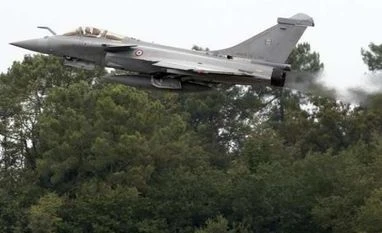 "IAF chief blames UPA for procurement delays, spells out schedule for boosting fighter squadrons")


