
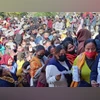
 "Right to live before right to vote: Common refrain in Manipur relief camps")


"Why should I vote to elect a representative of a place which is no longer mine... elections mean nothing to us," says a distraught Nobi who lost her home 11 months ago to ethnic violence in Manipur, and is living in a relief camp.
The 42-year-old is not alone as 'right to live before right to vote' and 'peace before polls' was the common refrain of many who have not been able to return to their home due to recurrent clashes and lingering hostilities between the warring ethnic groups in the northeast state.
The state has traditionally seen a very high voter turnout with more than 82 per cent polling recorded in the 2019 elections. But the ethnic violence has cast a shadow on the polls this time around with several civil society groups and the affected people questioning the relevance of holding elections in the current circumstances.
"The government hasn't been able to ensure my right to live with dignity and they are going to ensure my right to vote?" Nobi asks. "My house was burnt in front of my eyes. I and my family left overnight. We do not even know what is left there."
"Why should I vote for representative of a place which is no longer mine? This is all a gimmick... Elections mean nothing to us," Nobi told PTI.
The hills state has witnessed sporadic, sometime intense, ethnic clashes since May 3 last year between the majority Meitei community and Kukis, resulting in loss of over 200 lives. While Meiteis have concentrated in Imphal city while Kukis have shifted to the hills.
The elections for two Lok Sabha seats in Manipur will be held in two phases on April 19 and 26. While Inner Manipur and some segments of Outer Manipur will vote in the first phase on April 19, the remaining segments of Outer Manipur will vote in Phase 2 on April 26.
According to officials, more than 50,000 people are living in camps following the unrest.
They question the timing of the Lok Sabha elections and say the idea of organising voting in relief camps is nothing but a gimmick as the real issues remain unaddressed.
PTI visited four relief camps in the Imphal Valley where the displaced people expressed discontent with the poll process.
Eighteen-year-old Dima, who has finished her schooling under the shadow of the conflict, said she has no idea what she is going to do next.
"How can I plan studying further in such a situation? And why should I waste my first vote at a time when I feel elections should not be conducted... I won't," she told PTI.
Living in a relief camp set up in the Government Dance College auditorium in Imphal's Peace Compound, Dima spends her day teaching primary school children who have begun going to a nearby government school.
The Election Commission has announced that the displaced population will have the opportunity to cast their votes from relief camps.
KH Khamba (45), who used to run his transport business in the Kuki-dominated area of Moreh, a town near the Indian-Myanmar border which is 120 km away from his relief camp, said, "There had to be some resolution for the current situation before elections were conducted."
"What did the people we vote for in past do for us? Yes, we are being kept in camps, food is being given but is that all that is needed to live?" he said. "We left amid the violence and got to know later that my vehicles as well as my house are no longer there as everything has been burnt."
Asked whether he will cast his vote, Khamba said, "We are still consulting among ourselves but one thing is sure that we are not happy about the timing of elections in the state."
Thirty-year-old Melody helps out in cooking meals at the camp and also tries to learn incense making to earn a livelihood.
"If the government can conduct elections during such a time, I am sure they can find ways to bring peace and address the concerns of people. Everything that we had built over the years got burnt and now we are supposed to start our lives from scratch and we should also vote?
"Bringing up my two children at a relief camp is not the life I had imagined for myself," she said.
According to Election Commission officials, over 24,000 people living in the relief camps have been found eligible to vote and 94 special polling stations are being set up for the purpose.
Posters of political parties, mega rallies and visible movement of leaders -- the traditional elements of campaigning -- are conspicuously missing in the strife-torn state.
The only visible hint of elections is the hoardings put up by local election authorities, urging citizens to exercise their franchise. Major party figures have refrained from visiting the conflict-ridden state to canvass for votes or make electoral pledges.
(Only the headline and picture of this report may have been reworked by the Business Standard staff; the rest of the content is auto-generated from a syndicated feed.)
You’ve reached your limit of {{free_limit}} free articles this month.
Subscribe now for unlimited access.
Already subscribed? Log in
Subscribe to read the full story →

Smart Quarterly
₹900
3 Months
₹300/Month
Smart Essential
₹2,700
1 Year
₹225/Month
Super Saver
₹3,900
2 Years
₹162/Month
Renews automatically, cancel anytime
Here’s what’s included in our digital subscription plans
Exclusive premium stories online

Over 30 premium stories daily, handpicked by our editors


Complimentary Access to The New York Times
News, Games, Cooking, Audio, Wirecutter & The Athletic
Business Standard Epaper
Digital replica of our daily newspaper — with options to read, save, and share


Curated Newsletters
Insights on markets, finance, politics, tech, and more delivered to your inbox
Market Analysis & Investment Insights
In-depth market analysis & insights with access to The Smart Investor


Archives
Repository of articles and publications dating back to 1997
Ad-free Reading
Uninterrupted reading experience with no advertisements


Seamless Access Across All Devices
Access Business Standard across devices — mobile, tablet, or PC, via web or app