


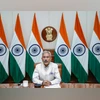
 "Conflict in West Asia resulting in disruptions in trade flow: Jaishankar")


The disruptions in crucial shipping routes and trade flows triggered by the ongoing conflict in West Asia strengthened the case for de-risking, External Affairs Minister S Jaishankar said on Friday.
In an address at an India-Mediterranean business conclave, Jaishankar, referring to the proposed India-Middle East-Europe Economic Corridor (IMEC), said it aims to become a "cornerstone of global connectivity".
"The ongoing conflict in West Asia understandability has generated concerns about some of the contemporary initiatives," he said.
"Disruptions in crucial shipping routes that have increased shipping costs and necessitated the rerouting of trade flows, have added to our collective worries," Jaishankar said at the conference hosted by Confederation of Indian Industries (CII).
"But if you reflect on these happenings, they only strengthen the case for derisking. As the three hubs of India, Europe and the Middle East step up their interactions, connectivity will be more needed, not less," he noted.
There were spate of attacks on merchant ships in the Red Sea by Houthi militants earlier this year apparently in response to Israel's military operation in Gaza.
On the IMEC project that was announced on the sidelines of the G20 summit in Delhi last year, the external affairs minister said it has opened promising new perspectives.
"The IMEC aims to become a cornerstone of global connectivity, providing a robust framework for boosting trade and other flows across critical regions," he said.
"By integrating innovative logistics and sustainable practices, it holds the potential to significantly contribute to both growth and resilience," he added.
Jaishankar also underlined the importance security and stability.
"In a volatile and uncertain world, security and stability have to be an integral part of the calculation," he said.
"Hence, it is natural that strengthening defence and security cooperation with Mediterranean nations should actually parallel deeper economic links," he added.
"This has taken the form of exercises, consultations and exchanges. But in an era of rapidly emerging technologies and supply chain disruptions, there is a strong case for more industry interaction."
"After all, Make in India has now taken deep root in the defence domain as well," he said.
(Only the headline and picture of this report may have been reworked by the Business Standard staff; the rest of the content is auto-generated from a syndicated feed.)
You’ve reached your limit of {{free_limit}} free articles this month.
Subscribe now for unlimited access.
Already subscribed? Log in
Subscribe to read the full story →

Smart Quarterly
₹900
3 Months
₹300/Month
Smart Essential
₹2,700
1 Year
₹225/Month
Super Saver
₹3,900
2 Years
₹162/Month
Renews automatically, cancel anytime
Here’s what’s included in our digital subscription plans
Exclusive premium stories online

Over 30 premium stories daily, handpicked by our editors


Complimentary Access to The New York Times
News, Games, Cooking, Audio, Wirecutter & The Athletic
Business Standard Epaper
Digital replica of our daily newspaper — with options to read, save, and share
Curated Newsletters
Insights on markets, finance, politics, tech, and more delivered to your inbox
Market Analysis & Investment Insights
In-depth market analysis & insights with access to The Smart Investor


Archives
Repository of articles and publications dating back to 1997
Ad-free Reading
Uninterrupted reading experience with no advertisements


Seamless Access Across All Devices
Access Business Standard across devices — mobile, tablet, or PC, via web or app