


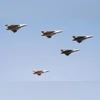
 "India's 5th-gen fighter looks to move off the drawing board, into the air")


The US has its F-22 Raptor, and F-35 Lightning II; Russia has its Sukhoi-57; China has its J-20 Chengdu, and J-31 Shenyang — all of them 5th-generation (Gen-5) combat aircraft built to rule the skies.
The Indian Air Force (IAF) isn't ready to be left behind. With the experience gained from building the Tejas light combat aircraft (LCA), New Delhi is pushing its aircraft production monopoly, Hindustan Aeronautics Limited (HAL), to join hands with the Defence Research & Development Organisation’s (DRDO)’s Aeronautical Development Agency (ADA) to build an Indian Gen-5 fighter, dubbed the Advanced Medium Combat Aircraft (AMCA).
Business Standard was granted an exclusive briefing at HAL Bengaluru on the progress of the AMCA project.
“The [AMCA] project has just begun and it is coming along well. We are building in close cooperation with ADA. About 35-40 per cent of the aircraft has been allocated to HAL to design. The rest of the aircraft is being designed by ADA. There is no third design partner,” said CB Ananthakrishnan, HAL’s chairman and managing director (CMD).
The Ministry of Defence (MoD) is keen on bringing in private industry immediately at the design and development stage. However, private firms would like to participate in production programmes only after completing design and development to avoid locking in funds during an inevitably long gestation period.
The AMCA’s Comprehensive Design Review (CDR) was completed in December 2023. HAL will now have to develop some systems and build five prototypes – a four-year-long job.
HAL officials briefed Business Standard that the AMCA’s stealth shaping was now complete, its design now mature, and its internal systems fully laid out. The way is clear for metal cutting – the symbolic start of constructing a flying prototype.
Stealth is health
Stealth fighters are crucial at the start of a war. Being almost invisible to a radar, they fly deep into enemy airspace on “interdiction” missions to strike enemy radars, air bases, and control centres. The “air superiority” thus created allows non-stealthy fighters like Sukhoi-30MKI, Jaguars, and Mirage 2000s to penetrate enemy airspace and strike enemy targets such as roads, railways, airfields, depots, and ground forces without incurring heavy casualties.
In the event of a war with China, AMCA deep strikes would target China’s rail and road links with Tibet, isolating the People’s Liberation Army (PLA) divisions there.
Four advanced capabilities make Gen-5 fighters so lethal: Their “stealth”, or near-invisibility to enemy radars, is magnified by an ability to “supercruise”, or fly at supersonic without engaging the engines' fuel-guzzling afterburners. Third, its advanced avionics enhance the pilot-aircraft interface, allowing a single pilot to both fly and fight the aircraft. Fourth, its powerful radar can detect and engage targets from far — outranging its adversaries.
In stealth mode, the AMCA conceals its fuel and weapons in an internal bay, since carrying them under-wing creates protrusions that reflect radar waves, and compromise stealth. In stealth mode, the AMCA’s “all-up-weight” (AUP) of 20 tonnes allows it to carry a mere one-and-a-half tonnes of munitions, concealed in internal weapon bays. In non-stealth mode, an additional five tonnes of munitions and fuel payload can be carried on external, under-wing stations.
However, given the AMCA’s strategic value and cost, its primary task would probably be stealth missions, using armament carried on four weapons stations in internal bays. On deep penetration strikes, the AMCA would carry up to 6.5 tonnes of fuel in internal tanks. That is sufficient to strike targets 1,000 kilometres inside enemy territory, and return to base.
In “non-stealth” mode, with its weapons on six external stations, internal fuel tanks can carry an additional 1,200-1,300 litres of fuel, increasing its capability as a potent long-range, non-stealthy bomber.
Engines for super-cruising
Another key AMCA design challenge is to develop an indigenous, “super-cruising” engine. Until then, the AMCA will be powered by twin General Electric (GE) F-414 engines. These engines, in single-engine configuration, will power the Tejas Mark 2.
DRDO officials say: “The F-414 engine generates up to 98 KiloNewtons (KN) thrust, which effectively degrades to 90 KN in Indian climatic conditions. We have calculated that an AMCA, with the configuration the IAF has specified, requires a thrust of 220 KN (in Indian conditions) for super-cruising. That means it requires twin engines, each generating 110 KN thrust.”
Former Defence Minister Manohar Parrikar had estimated the AMCA would cost about $4 billion to develop, with a major share going into developing the engine. In 2015, India set up a “joint working group” (JWG) with America to co-develop jet engine technology. In October 2019, US Under Secretary of Defence Ellen Lord, on a visit to Delhi, revealed the JWG had been scrapped since US export control laws prevented the export to India of key technologies that the DRDO wanted.
With almost a decade of work and Rs 400 crore gone into the AMCA, responsibilities are now being reassigned. The serial production of the AMCA was handed over to HAL’s Nashik Division, which has, for the last two decades, been engaged in manufacturing the Sukhoi-30MKI.
Ananthakrishnan says there now a proposal to form a special purpose vehicle (SPV), with a private sector partner. ADA and HAL will take a 50 per cent stake, with the private partner holding the rest. “However, we have yet to find a suitable private partner,” he said.
HAL will do the complete structural design of the AMCA, except for the centre fuselage, which ADA will design.
“There is no clarity on how these private companies could be chosen. For the time being, the Cabinet Committee on Security (CCS) paper says to go ahead with 50 per cent ownership each with ADA and HAL. When the private sector firms are ready to join, they can be invited,” said the HAL chief.
Series concludes
One subscription. Two world-class reads.
Already subscribed? Log in
Subscribe to read the full story →*Subscribe to Business Standard digital and get complimentary access to The New York Times

Smart Quarterly
₹900
3 Months
₹300/Month
SAVE 25%
Smart Essential
₹2,700
1 Year
₹225/Month
SAVE 46%
*Complimentary New York Times access for the 2nd year will be given after 12 months
Super Saver
₹3,900
2 Years
₹162/Month
Subscribe
Renews automatically, cancel anytime
Here’s what’s included in our digital subscription plans
Exclusive premium stories online

Over 30 premium stories daily, handpicked by our editors


Complimentary Access to The New York Times
News, Games, Cooking, Audio, Wirecutter & The Athletic
Business Standard Epaper
Digital replica of our daily newspaper — with options to read, save, and share


Curated Newsletters
Insights on markets, finance, politics, tech, and more delivered to your inbox
Market Analysis & Investment Insights
In-depth market analysis & insights with access to The Smart Investor


Archives
Repository of articles and publications dating back to 1997
Ad-free Reading
Uninterrupted reading experience with no advertisements


Seamless Access Across All Devices
Access Business Standard across devices — mobile, tablet, or PC, via web or app
SAVE 25%