


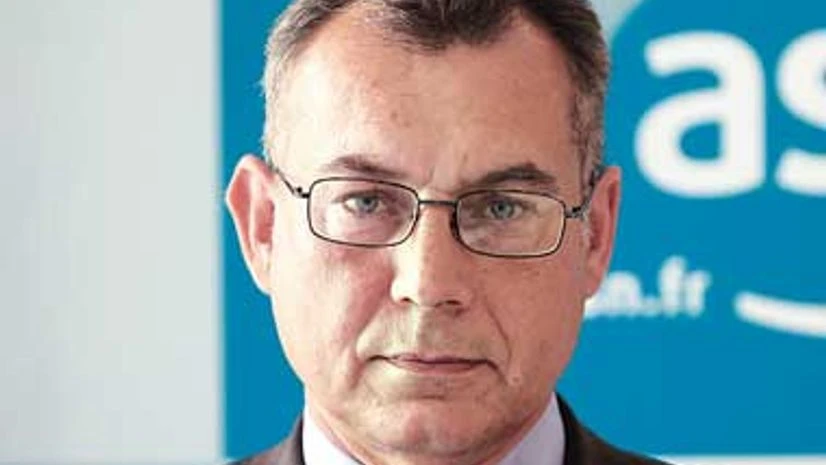
 "In nuclear power, we and you need to take safety and quality issues very seriously: Pierre-Franck Chevet")
Last month, India and France signed a deal to make what could become the world's biggest nuclear park, with six European Pressurised Reactors (EPRs) of 1,650 Mw each in Maharashtra. EDF, France's public electricity producer and supplier, now leads the negotiations. However, EPR is also facing problems. Pierre-Franck Chevet, head of the Nuclear Safety Authority in France, called ASN, speaks to Noopur Tiwari. Edited excerpts.
You said nuclear safety & security in France was worrying. Why?
There is a risk that in the years to come, if financial difficulties persist, businesses would be tempted to not undertake or delay investments related to safety.
The anomalies in the nuclear plant at Flamanville in France were discovered by whom?
They were essentially discovered because we at ASN had insisted on additional tests. There was reluctance (from the companies) but we finally got them to do these tests, the anomalies were found.
What is the nature of the problems in the French EPR and their impact?
If we know we have had an anomaly, you can ensure that Indians do not repeat the mistake. For Flamanville, yes, there is a serious anomaly, an excess of carbon in the metal and it could render the pressure vessel, which ought to be very resistant, more fragile. We have asked for many more tests and these will be done only by end-2016. Then, ASN will take some months to analyse and take a stand.
Are there chances that the reactor might have to be rebuilt from scratch?
It's possible. For the moment, we don't know. EDF and Areva (the entities involved) have to study the possibilities in terms of solutions.
Will it be hard to determine if the problem is with the design or with the construction and whether these are linked? Shouldn't India wait more?
No, it's not a problem of design. But, yes, the EPR has had problems with all constructions. We even had problems related to cement and we stopped construction until the problem was fixed. There is an enormous amount of technical work. Everything needs to be tested for quality, from manufacturers to service providers. The stakes are huge. The Indian authorities should make the same moves as we have done at ASN. It's their responsibility. We can help once the reactors are bought.
Who should be held responsible in case of an accident? We have had issues of civil liability in the past in India, with Bhopal in 1984. The law puts the onus on equipment suppliers. But, for the French EPRs in India we have a 'Make in India' push. This will confuse matters.
The responsibility is first and foremost with the nuclear operator. Whether it's the design, construction or anything else. In India, it would be the NPCIL (government-owned Nuclear Power Corporation of India). It's for them to make sure every thing is in order and their first responsibility is towards safety, towards people.
Back in India, the autonomy of the AERB (Atomic Energy Regulatory Board) had been questioned by some. How important is the independence of any nuclear safety regulatory authority?
Extremely essential. ASN (French Nuclear Safety Authority) was created in 2006 by a law as independent from all stakeholders--- especially from the government, the operators, and even the NGOs. By law, ASN is answerable only to the Parliament and to the people. Our role is to look into safety; not to be pro- or anti-nuclear.


